Let your favourite author be your mentor for free!
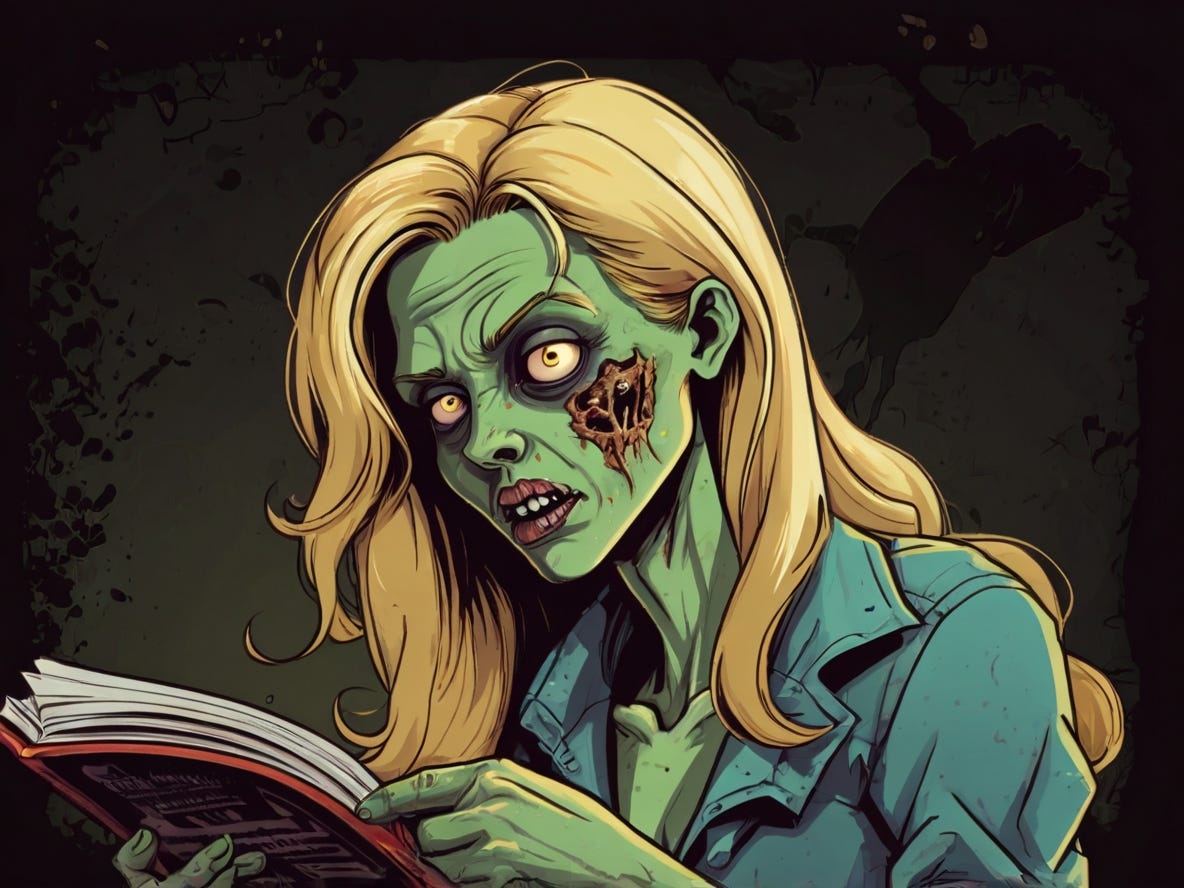
Are you a zombie reader? Does drool stain your pages as your eyes sway over the page? Mindless dribble to numb daily pain.
Well, good for you. There is a time and place for being a zombie consumer. Just remember, in the bedroom, there needs to be consent — no zombies allowed.
Our brains need to escape from reality to remain sane. Books are a mental holiday. But they can be so much more. They can be teachers.
Unfortunately, when we read like zombies, we don’t take in all the story and the rich details evaporate. For most of us, only the overall plot or key moments will stick.
There is a golden rule of advice writing gurus peddle and I’m sure you’ve heard it — to be a fabulous writer, one needs to read a lot. But what told you that’s bulldust, and every time you hear the words a muse dies?
Zombie reading, more commonly known as passive reading, will not teach a writer much about the craft of writing. It’s a mind holiday. Think of it as going through life and never reflecting. Personal growth is stunted.
For books to become mentors, writers need to become active readers. Active reading takes more effort than zombie reading because active reading requires critical engagement with the text.
Active reading is akin to being an editor. You’re looking at the story elements; how is the story put together? What elements work? Or simply, what’s shit and what’s not?
There are several ways to read like a boss. Some readers highlight passages and write notes in the book’s margins. I am way too precious to do that to my books. Break the spine, and I’ll break your fingers.
I prefer to keep a reading journal and I can only endorse what works for me. There are two parts to my madness method.
1. Taking notes while reading
2. Analysing the book on completion.
Let’s slay the zombie!
The Reading Journal
You will need a reading journal. If you’re old-school, a notebook and pen are retro and cool. I struggle to read my handwriting, so I’ll be a techie and use my electronic journal. You’ll need nothing fancy smancy. Writers can be so picky about their tools.
Note: The free One Note app would make a fine choice for an electronic journal. Made by Microsoft, One Note entries sync between Mac, Windows, tablets, and phones. However, I use the journal app, Day One.
Part 1: Reading
Read the text with care. I know everyone likes a quickie, but don’t be a speed demon. Take the story in. Let the details seep into your brain. Pause after every scene and chapter.
In your reading journal, jot down a summary of the scene you just read. Only a sentence or two is necessary. These summaries create a story map for later reference.
The summaries also help you identify the story structure (plot points). Story structure is fundamental to crafting a fabulous story. You may add any random thoughts and impressions about the novel.
I read a scene in full before I write up summaries. I still want some reading pleasure.
Example
Recently, I actively read Stephen King’s “It”. I needed to learn from the master. The story structure and the weaving of a cast of point-of-view characters are in a league of their own. Arguably, “It” is King’s magnum opus, and it’s a meaty beast about a Ronald McDonald monster that preys on children and lurks in the sewer.
The story revolves around a group of childhood friends reuniting as adults to slay the monster. Two timelines intertwine childhood and adulthood, exploring the effects of childhood trauma and memory loss.
Examples are snippets from my reading journal. No plot point spoilers to bring out the sourpuss, but if you’re a sensitive snowflake (like I am), skip the easily identifiable examples (quotes, like the one below).
Part 2 — June 1958 (each chapter starts in 1985 and flashbacks to 1958)
Chapter 4 (Ben)
• On the plane flying to Derry, childhood memories flood back
• 1958
◦ Ben in class with Henry won’t let him cheat
◦ School’s out: Ben crushes on Beverly.
No, I didn’t cheat. I outlined every scene. Yes, it felt like a never-ending story. Over 1000 pages… Oh, I hate myself.
Part 2: Analysing the Text
Congratulations! You finished reading a book. Your mother must be so proud.
Now the fun…
Step 1: The Dump
Your brain is probably swimming with thoughts about the book you just read; mostly the dumb crap. Usually, the good is in there too. So this should be easy.
Grab some paper or open your app. A new journal page will do.
Write out two lists:
- The Good
- The Bad
Lists are a way to vomit out thoughts. Doing so helps organise thoughts and impressions after reading. You may add a third list “other” for neutral or random impressions that are beyond good or bad. If you get stuck, ask yourself —
What worked for me and what didn’t?
Don’t overthink the lists. Thinking comes next. The lists are a starting point, a dump. Do it on the toilet if you want to save time. Mine takes about 5 minutes and I jump back and forth between lists. Let it rip.
Step 2: The Deep Dive
The dump is complete. Don’t flush. It’s time to expand on those nuggets.
Every novel comprises universal story elements: story structure, plot, characters, point of view, language, setting, and world-building. These story elements are the foundations of narrative storytelling.
This guide will briefly go through every story element and offer journaling questions for you to ponder. Write as much or as little as your heart desires. We all operate with a different knowledge base and start as noobs.
⭐️ Story Structure
Story structure is the story’s skeleton. To grossly simplify:
Every story has a beginning, middle, and end — The three-act structure. The acts are the bones of the story and the turning points (where the big plot stuff happens) are the joints between the acts.
In your journal:
- Identify the acts and turning points
Refer to your scene/chapter notes as needed. Research story structure if you’re looking at the screen like a deer in headlights. Or skip it.
Example
“It” is a mammoth of a book. The doorstopper is broken up into 5 parts. I assumed the story structure was going to be unique, especially with the jumping between timelines. There are exceptions to every writing rule, of course. To my surprise, the “part” labels are cosmetic. The three act structure is present.
Act 1/Part 1 sets up the story. 1985, It is back and our main characters are recalled as adults to slay the monster.
Act 2a/Part 2 We learn about their first encounters with It, and life growing up in 1958.
The Midpoint sits at the beginning of Part 3. 1985 and the kids, now adults, meet for the first time in decades. New shenanigans begin.
Act 2b covers most of Part 3 and 4. We learn about more serious encounters with It as the adults remember their traumas and the threat becomes intense.
Act 3/Part 5, the timelines are woven so they are read parallel with each other and conclude together. Showdown with the monster. Characters’ fate are revealed.
The novel isn’t a perfect match to the three-act structure, but the story shifts and turning points are present in a roundabout way.
⭐️ The Plot
The plot is the happenings in the story—a series of actions and reactions. Conflict drives the plot as characters chase their needs and wants.
- Did the novel follow story logic?
- Were there any plot holes or lame parts?
- Did the characters act out of character at any time just to move the plot forward?
- Were there any filler scenes that slowed the story down and were pointless?
I won’t comment on the plot. Anyone who has read “It” knows there is a WTF moment. Actually, there are a few. But I don’t want to spoil the fun. Don’t write on coke and coffee people. Overall, the plot worked but the book could have been edited for a tighter read.
⭐️ Characters
Characters make or break the story. They are what readers relate to the most. Great characters can allow readers to overlook story flaws.
- Were the characters relatable or at least believable?
- Did you want to put anyone’s head in the blender?
- Did you have any emotional reactions towards the characters?
- Did you root for them or want to hire a hitman?
The characters in “It” were among the best ever written. A bit dated having one female in the group. But overall, the dynamics between “The Losers” made the story. The book isn’t about the big bad. It’s about growing up and friendship. Each of the seven kids, plus their bullies had distinctive personalities. That can be hard to pull off for a writer.
⭐️ Point of View
Novels are typically written in a third-person variant or from a first-person point of view.
Third-person omniscient is the God-like point of view jumping from character to character, and third-person close sticks to one character per scene and follows their actions and private thoughts.
First-person is like reading someone’s diary — all about me, myself, and I.
There are pros and cons to each point of view type.
Many books have multiple point-of-view characters. Some have too many, making the story distant and hard to follow.
- Did the point of view work in the book you read?
- Do you wish the story was told through another character’s eyes?
- Did you grow bored?
- If the story was written in the third person, was there head hopping?
Stephen King’s “It” had an army of point of view characters. Most books have no more than three. Each point of view character a writer adds risks creating a distance between the story and the reader.
To combat the risk, the modern trend is to focus on fewer characters and write in third-person limited or first-person. “It” was mostly written in 3 person omniscient. In places, the head hopping jarred. And I felt a distance between me and the characters. Several characters were only starred once or twice and the point of view could have been assigned to on of the the main characters.
Overall, the army of characters worked. No confusion for the reader. Most chapters read like a short story with minimal point-of-view characters.
⭐ Setting
Some stories are written to showcase a time and place. Historical fiction only works set during the designated time period. Places and times have unique social norms, cultures, and politics that can be plot drivers. For example, technology makes some stories impossible to modernise.
- Could the story have been set anywhere else and still work? Why or why not?
“It” is set in a fictional US town, Derry. The bulk of the story takes place during two time periods,1958 and 1985. The plot revolves around preteens having the freedom to roam as they please. Such freedom went out of vogue with the 90s.
Playing practices have changed. It’s all about screen time now. Even if kids still culturally roamed, they would be trying to make It a Tik-Tok star… might be a fun idea to explore. I’m not sure It could operate under the radar though. Would 21st-century parents get away with being neglectful?
⭐️ Language
Language adds texture to a story. Words paint a mental picture.
- Did the writer pen too many descriptive details or not enough?
- Was the book an easy read or were you rereading lines and looking up words?
- Did the dialogue work?
- Did the language match the setting?
- Was the language dull?
“It” suffered from too much detail. A lot of the details went over my head, and conjuring a picture with my mind’s eye was challenging in parts. I imagine this is a personal assessment. I’m not American and 1958 is well before my time.The banter between the children was rich. Beep Beep.
⭐️ World-Building
Not all books are equal when it comes to world-building. Some are light, set in the everyday modern world and others are set in fantastical worlds that resemble little, if anything, to our reality.
Historical fiction and niche genre writers need to research to build credible worlds. A crime writer needs to know about crime procedures. A medical drama writer requires medical knowledge.
Did the writer do their research? Were there any errors?
Stories with fantasy or sci-fi elements have a mythos, a set of story rules that govern the story world.
How does the magic system or technology work?
Are there gaps in the mythos?
Does the mythos make sense?
Are there any mythos contradictions?
Please skip the snippet from my reading journal; there might be a spoiler for a 4-decade book!
King offers contradictory explanations as to who or what it is — killer clown, alien, spider, a weird imaginary fiend from another realm, the town Derry, the evil people do? My head hurts. I’m sure my entry reads like I’m on coke. Thanks Mr King. Best writing mentor ever!
Step 3: Dare to Do Better
By this stage, you have torn the novel to shreds. You have an understanding of what can be saved and what needs flushing. Fun, wasn’t it?
Don’t be so snug. You can only be a smug bastard if you can answer this question:
How would I rewrite the story?
Fix the bad. Be arrogant. You can do better than this writer. Write a story synopsis. You’re now an almighty editor and ruler of that fictional world.
Fixing flawed stories sharpens your writing skills. It’s easy to hate something and it’s a lot harder to find solutions. The more you do this exercise, the stronger your own stories become. It’s a challenging exercise. Changing one story element has a knock-on effect.
So can I take on King?
The short answer is, “no”. I would edit out some of the bloat, that’s a given. The characters are the book’s strongest element, along with the concept.
For me, the major flaw with “It” is the ending. In all fairness, the final showdown with the big bad in any story tends to feel anticlimactic. Those endings are the hardest to pull off after a fantastic build up. King seemed to have backed himself in a corner and ran out of steam. The final act is rushed and odd… Turtle shit weird comes to mind.
The big screen adaptation “It: Chapter 2” fixed the major issues I had with the book. No shitty-shitty-bang-bang. The movie has a close to a perfect ending… Like anything in life, there are a couple of nit-picky things that make me want pop a balloon over. But you know, spoilers.
Bonus Journal Questions for Advanced Writers
For seasonal writers who have taken courses or read extensively on writing theory.
- How did the novel hold up against your creative writing knowledge?
- Did the writer break any writing rules? If so, was the rule-breaking a flop or a win?
- Did the writer stick to genre conventions?
What I learnt by keeping a reading journal
Keeping a reading journal is like having a free mentor. I chose to reread “It” with a purpose — to fill a blindspot in my story-crafting knowledge. Not because I hate myself.
Writing courses and books offer standard advice on writing for standard novels but neglect complex stories that are epic.
In the back of my mind, an old failed novel series nags to be worked on as it does every so often. The story is strong. The characters rock. Several university lecturers raved about the series while I was attending film school. Inspired by the cult classic “Twin Peaks”, there is a lot to love.
However, converting television format with a cast of characters… well, let’s just say it doesn’t translate. My novel translations jump around from character to character, making it a jarring read.
Most novel writing gurus advise against more than a few point-of-view characters, and for good reason — it’s much easier to write a tight story that resonates with readers when there are only one or two protagonists involved.
Of course, I like to do everything the hard way and bang my head on the keyboard.
My “Twin Peaks” is a multi-generational tale, with several secrets being revealed relating to different eras. Weaving the story threads together is a skill challenge. I need a cast of characters to tell the whole story. If I’m honest, my writing skills haven’t been at a level where I know how to fix my ugly baby.
This time, I turned to the master, Stephen King. In my youth, I zombie-read the tome in three days with bloodshot eyes. I knew the novel was structured differently from the average book — many parts, story threads, flashbacks, and characters. A lot like my “Twin Peaks”.
How did the King tackle such a challenge?
King juggled six main characters and a host of others. In some places, the jumping to new characters felt too much, but mostly, having a small army of point-of-view characters worked.
Chapters reminded me of short stories, and the switching between point-of-view characters from scene to scene flowed, especially on occasions when the new point-of-view character was in the scene before, like handing over the torch.
There was some repetitiveness, but that’s more of an editing issue and writer indulgence. When you’re as big as King, you are The King.
Scenes within a chapter were often short, encouraging a fast read. The chapters feel complete. Several chapter stories tied together and formed parts.
Each part ended with an interlude — aka Mike’s largely uninteresting diary (some fans love ‘em, don’t troll me). Chunks of the interludes act as an info dump about the town’s history. As a concept, Mike’s diary worked for me, but jeez, make them sexy. Turn Pennywise into a hooker or something. I digress…

The mentorship is complete. My verdict for “Twin Peaks” ― I’m keeping the multiple points of view. The story can’t be told any other way, but I’ll assign one character per storyline and slowly build up my point-of-view cast. I want the reader to feel invested.
Inspired by King, I’ll try to treat each chapter as a short story focusing on a starring character. I will use a close third-person point of view. I craved a close third person while reading “It”. The omniscient point of view in places keeps a distance between the reader and the characters. Plus, the random head-hopping is a crime.
I’ll add diary entries, news reports, and letters to my arsenal. I’ve toyed with the idea for years, but it’s knowing how to weave it all together. King showed how it could be done.
Final Thoughts
Keeping a reading journal is one of the best teachers you’ll ever have as a writer. There are limitations; a journal won’t replace writing-guru lectures, books, courses, or blog posts on the art of writing.
However, keeping a reading journal will help you apply the writing theory you obtained elsewhere. Or, at the very least, a reading journal, like any other journal, is a place to vent.
Dear Diary,
Why, oh why, did I read THAT scene again? Like maiming children in drains isn’t enough. King is one sick clown. I suspect I’m not any better.


 THE WRITING ASYLUM
Leave a reply to Yvonne Cancel reply